

Complexity and Its Discontents
Populism and the Illusion of Simple Answers to Complex Problems

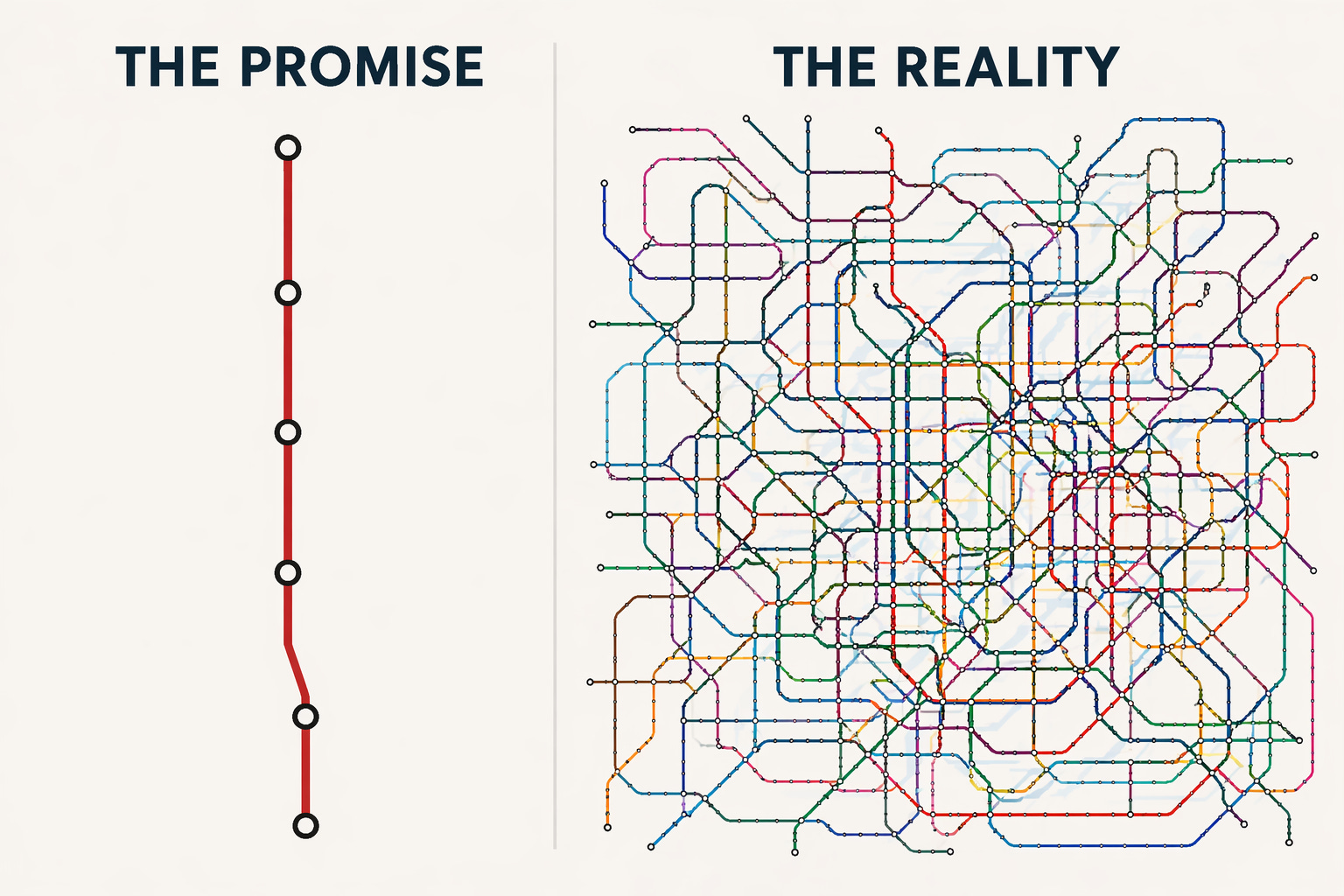
EARLIER THIS WEEK, I participated in a discussion at the Center for American Progress between American and European colleagues on the trajectory of populism in Europe and the United States, and its implications for transatlantic relations.
Without getting into the specifics of that conversation, it left me thinking about something more fundamental: the enduring appeal of simple answers in an increasingly complex world.
Populist movements, whatever their ideological orientation, tend to promise a false sense of clarity in a world that is anything but simple. They reduce complicated systems—global trade, migration, security, governance—into digestible narratives with neat causes and straightforward solutions: leave the European Union and reclaim prosperity; raise tariffs and restore economic strength; withdraw from international commitments and regain control.
These messages resonate not because they are accurate, but because they speak to something deeply human—the desire for the world to make sense.
But the truth is more difficult: life is complicated, and it is becoming more, not less, so.
Ignorance Can Be Bliss
I am often reminded of how much our relationship to complexity has changed. In the late 1990s, when I was working on post-war recovery in Bosnia, connectivity was sparse and fragile. We spent most of our days in the field, dealing with immediate, concrete realities. Communication with headquarters in Sarajevo was delayed, imperfect, and often frustrating. Email, when it worked at all, came through slow dial-up connections—sometimes routed in improbable ways, like long-distance calls through Croatia just to get a message out.
There were real downsides to that world. Conversations in Sarajevo often unfolded without full awareness of what was actually happening on the ground. Debates were prolonged, decisions delayed, and misunderstandings were common. At times, this led to circular discussions and wasted effort—people reacting to incomplete information rather than resolving it.
But there was also a kind of enforced discipline. You could not respond instantly. You had to gather information, reflect, and then communicate—usually in a single, deliberate burst at the end of the day. I would sometimes return after a long day in the field, log on, and find a long chain of emails about an issue in my area—dozens of replies piling up in quick succession, followed by a final message declaring the matter resolved, or that it had never been a problem to begin with—before I had even weighed in.
Imagine how much time I might have wasted—and how much longer those deliberations might have dragged on—if I had been in the office contributing in real time. Being physically away from the computer meant my attention was directed toward the work itself, not the constant management of incoming messages.
Moments of enforced distance like that have largely vanished. Today, constant connection has replaced enforced reflection. The expectation—often unspoken—is that everything must be answered immediately. Emails, messages, notifications all demand attention. Even stepping away for a few hours can produce real anxiety. And yet, once that anxiety fades, what follows is often relief—a reminder that not everything requires an immediate response. Sometimes, the quickest response is the least useful.

The False Prophets of Simple Answers
This tension between our desire for simplicity and the reality of complexity extends well beyond our personal lives. It defines much of our politics and policymaking.
There is a persistent nostalgia for a simpler past. In the United States, the 1950s are often invoked as a golden age. But this is selective memory. That period was also marked by the Cold War, nuclear anxiety, social tensions, McCarthyism, and ongoing military conflict. The world was not simpler; it only appears that way in retrospect.
What has changed is not the absence of complexity, but our exposure to it. We now see more of the world more quickly and more continuously, than ever before. Interconnections that once remained invisible are now immediate—and often overwhelming.
Into this environment step leaders who promise clarity. Often, they take the form of strongmen—figures who project certainty and control in the face of complexity.
That appeal is not accidental. In a world that feels fragmented and overwhelming, the promise of a single actor who can impose order and deliver straightforward solutions is deeply attractive. Complexity feels like weakness; simplicity feels like strength.
But that clarity is often illusory.
We saw it with Brexit: leave the European Union and reclaim prosperity. The reality proved far more complicated. The costs of unwinding decades of integration were underestimated, while the promised benefits largely failed to materialize.
We see a similar pattern in domestic policy debates. There is a recurring belief that large structural challenges—like the U.S. budget deficit—can be addressed through small, politically convenient cuts. Foreign assistance and medical research are often targeted not because they drive the deficit, but because they are easier to attack.
Yet these programs represent only a small fraction of total spending. Eliminating them would barely move the needle. Meanwhile, the real drivers—Social Security, healthcare costs, and broader structural dynamics—remain largely untouched because they are complex and politically difficult.
So we focus on the margins and avoid the core problem.
The same instinct appears in foreign policy.
There is a recurring belief that complex geopolitical challenges can be resolved through decisive, targeted action—precision strikes, air campaigns, demonstrations of force—producing quick, controlled outcomes.
But reality rarely cooperates. Airpower can degrade capabilities, but it rarely resolves the underlying political problem. Even after significant military action, actors like Iran retain the ability to respond asymmetrically—through proxies, missiles, and strategic geography. That is where complexity reasserts itself.
The consequences do not remain confined to the battlefield. They ripple outward into global energy markets, supply chains, and economic stability. A disruption in the Strait of Hormuz—a chokepoint for a significant share of the world’s energy supply—can affect everything from fuel prices to food costs.
What begins as a discrete decision becomes a systemic event with global consequences. There is no clean line between action and outcome—only a chain of reactions, many unintended.

Managing Complexity Instead of Denying It
This is the central problem: complexity cannot be wished away. It can only be managed.
None of this is to say that the desire for a less frenetic, less pressured world is misplaced. The constant demand for attention—the sense of being perpetually “on”—is real. But the solution is not to pretend the world is simpler than it is.
The world is not going back to a slower, less connected era. Nor was that era ever as blissful as we remember it.
If anything, the challenge is the opposite: to develop the capacity to live with complexity without being overwhelmed by it.
That requires discipline—resisting the urge for immediate reaction, accepting trade-offs, and recognizing that many problems do not have clean solutions. It also requires skepticism toward those who promise them.
The reality is less satisfying but more honest: there are no easy answers.
And yet, complexity is not only a burden. The same interconnectedness that creates vulnerability also creates opportunity. The modern world delivers enormous benefits precisely because it is complex.
We should be wary of longing for a world that never truly existed. The past may have felt simpler, but its complexities were merely different—and often less visible.
The task before us is harder, but more meaningful: to engage with the world as it is, not as we wish it to be—to navigate its complexity with honesty, humility, and a clear understanding that simplicity, while comforting, is often an illusion.
Excellent article!!! It should be required reading for everyone.